

8th Pay Commission Dearness Allowance Discussions Unfold in Mumbai
The 8th Pay Commission has completed its meeting schedule in Mumbai, engaging with employee and pensioner bodies regarding salary structures and work conditions.
8th Pay Commission Meetings and Stakeholder Talks
The 8th Pay Commission has wrapped up its scheduled series of meetings in Mumbai, where officials met with various employee associations, pensioners' bodies, and stakeholders. These sessions focused on key welfare topics, including pensions, general allowances, work conditions, and salary structures. While the Mumbai round has concluded, authorities have not yet announced the timetable for subsequent meetings across other regions.
Throughout various city consultations held over recent months, discussions surrounding the annual basic pay increment rate have taken center stage. Representatives for government workers note that an elevated annual increment could lessen reliance on periodic pay commissions for major financial adjustments.
Proposals for Annual Increment Rates
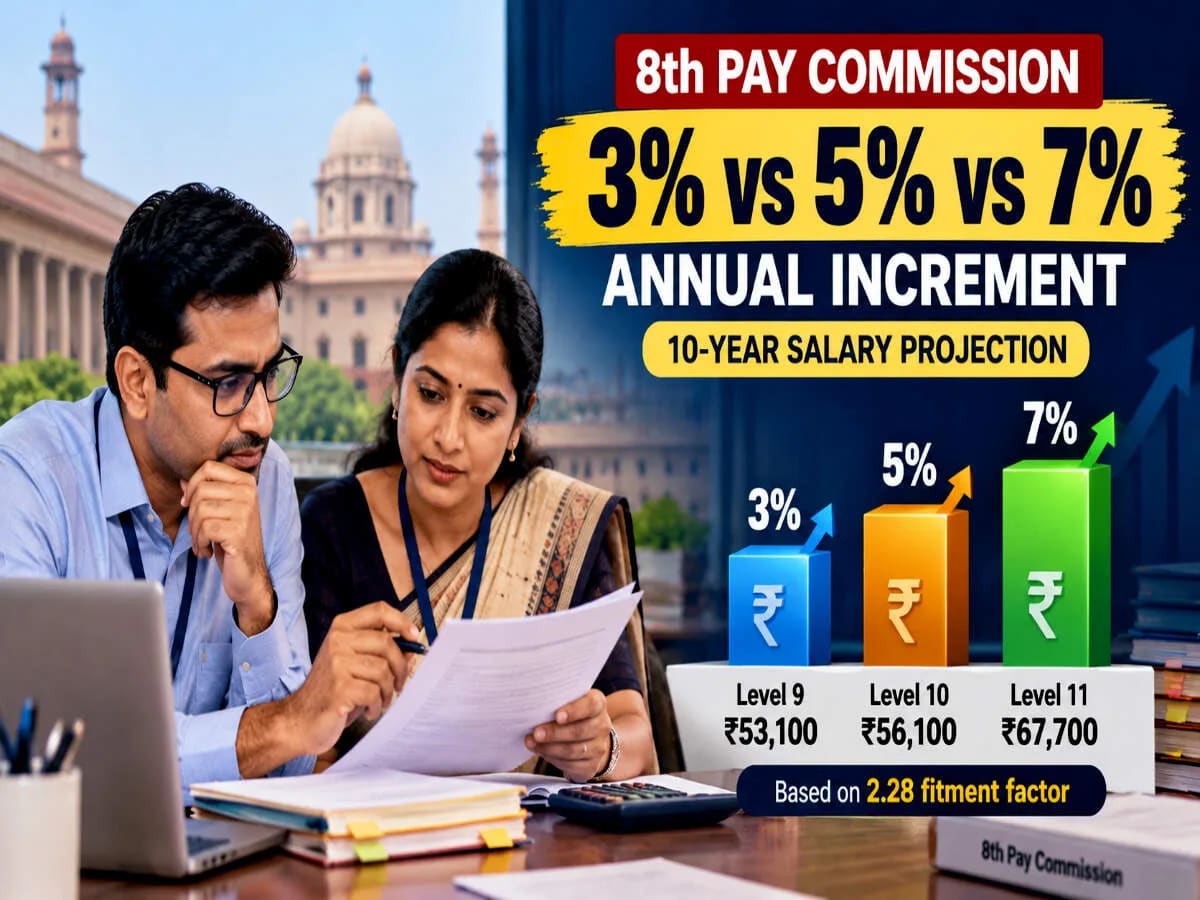
Labor organizations argue that the historical 3% annual increment results in a slow progression, forcing staff to wait ten years for substantial pay modifications. Statistics indicate that under the 3% annual hike model, basic pay for central government workers grew by just over 30% between 2016 and 2025.
To combat rising inflation and accelerate wage growth, multiple employee federations have submitted formal memorandums suggesting higher annual increment figures:
- National Council of the Joint Consultative Machinery (NC-JCM): Recommended a 6% annual increment rate.
- All India Defence Employees' Federation (AIDEF): Recommended a 6% annual increment rate.
- Federation of National Postal Organisations (FNPO): Recommended a 6% annual increment rate.
- All India New Pension Scheme Employees Federation (AINPSEF): Recommended a 7% annual increment rate.
- Indian Railways' Supervisors' Association (IRTSA): Recommended a 5% annual increment rate.
The AINPSEF notes that a 7% trajectory could potentially double an employee's gross salary within seven to eight years, offering a much-needed buffer for low-ranking staff against living costs.
Impact on Level 9, 10, and 11 Employees
To understand potential financial outcomes, projections evaluate how revised structures could affect specific employee tiers. Current starting basic pay figures stand at Rs 53,100 for Level 9, Rs 56,100 for Level 10, and Rs 67,700 for Level 11 personnel.
When applying a 2.28 fitment factor alongside 5% and 7% annual increment assumptions, estimated revised pay models show notable long-term gains over a ten-year span compared to the baseline 3% structure. For instance, Level 9 employees with an estimated initial revised pay of Rs 1,21,068 could accumulate extra earnings running into tens of lakhs depending on whether a 5% or 7% annual increment is ultimately adopted.
Further announcements regarding future meeting schedules and official decisions on the 8th pay commission dearness allowance and increment structures are awaited by workforce representatives across the country.
Sources: The Economic Times, The Economic Times, Kalkine India, The Times of India.
Related stories

Apple Stock Climbs After Q4 Earnings Beat, but Margins and China Drag
Apple stock jumped after the company posted Q4 earnings that beat expectations, driven by strong iPhone sales, but the share fell later as margin outlook and China revenue fell…

विशालकाय अजगर मिलने से ग्रामीणों में दहशत, वन विभाग की टीम ने किया रेस्क्यू प्रयास
बिजनौर जिले के एक गांव में खेतों के पास लगभग 100 किलो का विशालकाय अजगर दिखाई दिया, जिससे स्थानीय लोगों और किसानों में हड़कंप मच गया।

Rimi Tomy Marriage: Singer to Wed Trainer Libin Mathew in Mumbai
Malayalam vocalist Rimi Tomy confirmed her upcoming wedding to gym trainer Libin Mathew, with the ceremony set for November 14 at a Mumbai church.
Reliance Share Surges Following Record Quarterly Profit and Earnings Beat
Reliance Industries shares jumped nearly 12% in a record single-day gain, adding over $19 billion in market value following better-than-expected quarterly financial results.