

NASA Sls Rocket Upper Atmosphere Hole Observed During Artemis II Launch
NASA’s Artemis II launch created two large ionospheric holes, causing brief GPS positioning errors of several metres across the United States.
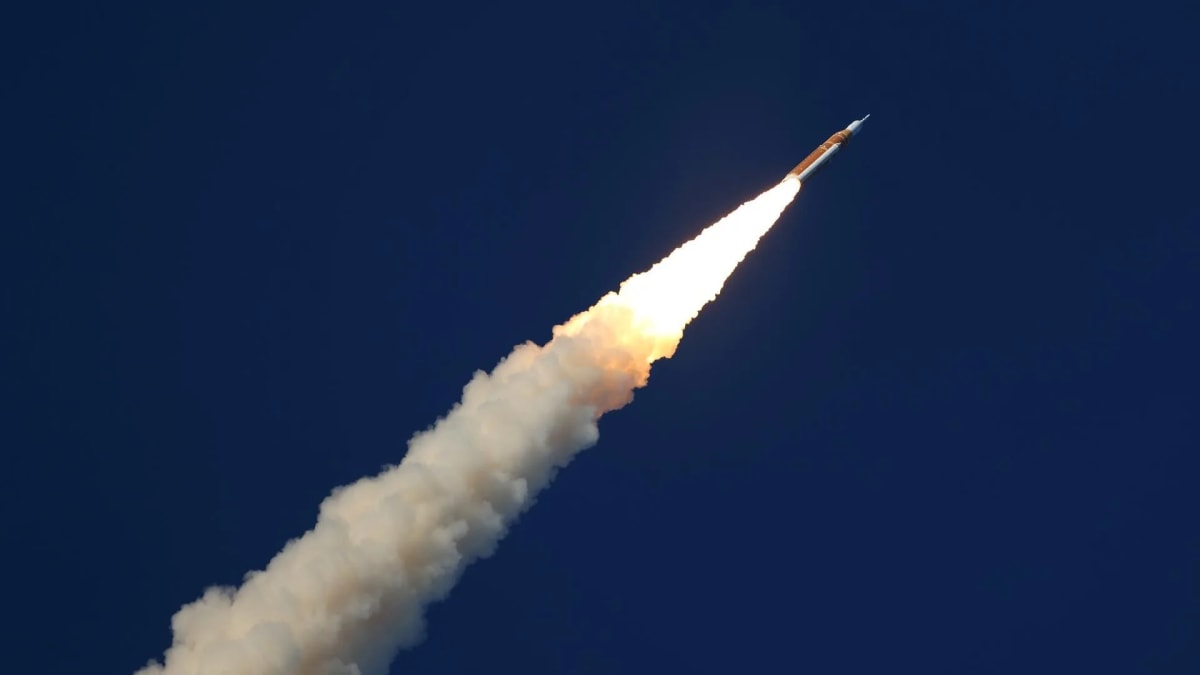
NASA’s Artemis II mission launched on 1 April 2026, and the powerful Space Launch System (SLS) rocket created two large disturbances in the ionosphere, effectively punching a hole in the upper atmosphere.
Ground‑based GPS receivers recorded temporary positioning errors of several metres, indicating that the ionospheric electron density had been altered along the rocket’s flight path.
nasa sls rocket upper atmosphere hole
Researchers from National Cheng‑Kung University in Taiwan examined high‑precision GPS data collected for tectonic‑plate monitoring. By tracking the travel time of GPS signals, they reconstructed how the SLS core stage and subsequent upper‑stage burns changed free‑electron concentrations above 30 miles (50 km). The analysis showed that the ionospheric impact of Artemis II was larger than any previous launch and up to ten times stronger than the disturbances measured after SpaceX’s Starship test flights.
Artemis II Ionosphere GPS Errors Hit 5,000 km
Two distinct “holes” were identified. The first followed the 212‑foot (65 m) core stage, and the second resulted from two upper‑stage burns at about 115 miles (185 km) altitude, more than an hour after lift‑off. Each hole stretched roughly 3,100 miles (5,000 km) across the United States, forming a transient contrail in the ionosphere.
Artemis II Ionosphere Hit: 3.7 TECU, No GPS Outage
Although the electron‑density changes corresponded to positioning errors of a few metres, the study did not observe a full GPS outage. The brief disturbance could nonetheless affect systems that rely on precise location data, such as autonomous vehicles and drones.
Comparison with other launches
The SLS’s thrust is greater than that of Starship, yet the ionospheric effect of the second‑stage burns—occurring inside the ionosphere—was more pronounced than the core‑stage impact. The researchers note that future lunar and Martian missions will likely produce similar effects, making the phenomenon a growing consideration for space‑weather forecasting.
Charles Lin, an earth‑science professor and co‑author of the pre‑print published in Geophysical Research Letters, emphasized that “a positioning error of a couple of metres is enough to cause an autonomous car to change lanes.” He warned that as launch frequency increases, the cumulative impact on navigation systems could become more significant.
The ionospheric holes dissipated within minutes, and normal GPS performance resumed shortly after. Ongoing monitoring will be needed to assess long‑term implications for satellite navigation as human spaceflight expands.
Sources: Space, https://tech-insider.org/, shattered.io.
Frequently asked questions
What caused the ionospheric holes observed after the Artemis II launch?
How large were the ionospheric disturbances?
Did the disturbances affect GPS accuracy?
How do these effects compare to other rocket launches?
Related stories

सारा तेंदुलकर के ऑफिस की दिवाली पार्टी और नए फोन की चर्चा
मास्टर ब्लास्टर सचिन तेंदुलकर की बेटी सारा तेंदुलकर ने अपने ऑफिस में दिवाली पार्टी का आयोजन किया, जिसमें उनका नया फोन भी चर्चा में रहा।

SC State vs Howard Football Matchup Preview and Predictions for Week 10
South Carolina State enters its college football matchup against Howard as a heavy favorite in Week 10. Analysts anticipate a strong defensive performance from the Bulldogs.

Uconn vs Michigan: Michigan Women's Basketball Ends UConn's Win Streak
Michigan women's basketball defeated No. 2 UConn 77-66, snapping the Huskies' 39‑game regular‑season run and marking the program's highest‑ranked victory ever.

എം.എ. യൂസഫലി Clears Kerala Bank Debt for Former Thalippuram Family
Former Thalippuram resident Ashwathi received full bank loan clearance after എം.എ. യൂസഫലി stepped in, enabling her family to move back into their sealed home.