

New Dwarf Planet Candidate Discovered Among Planets Beyond Neptune
Astronomers have spotted a large, icy object orbiting in the distant regions of our solar system that could qualify as a new dwarf planet.
Uncovering Worlds in the Outer Solar System
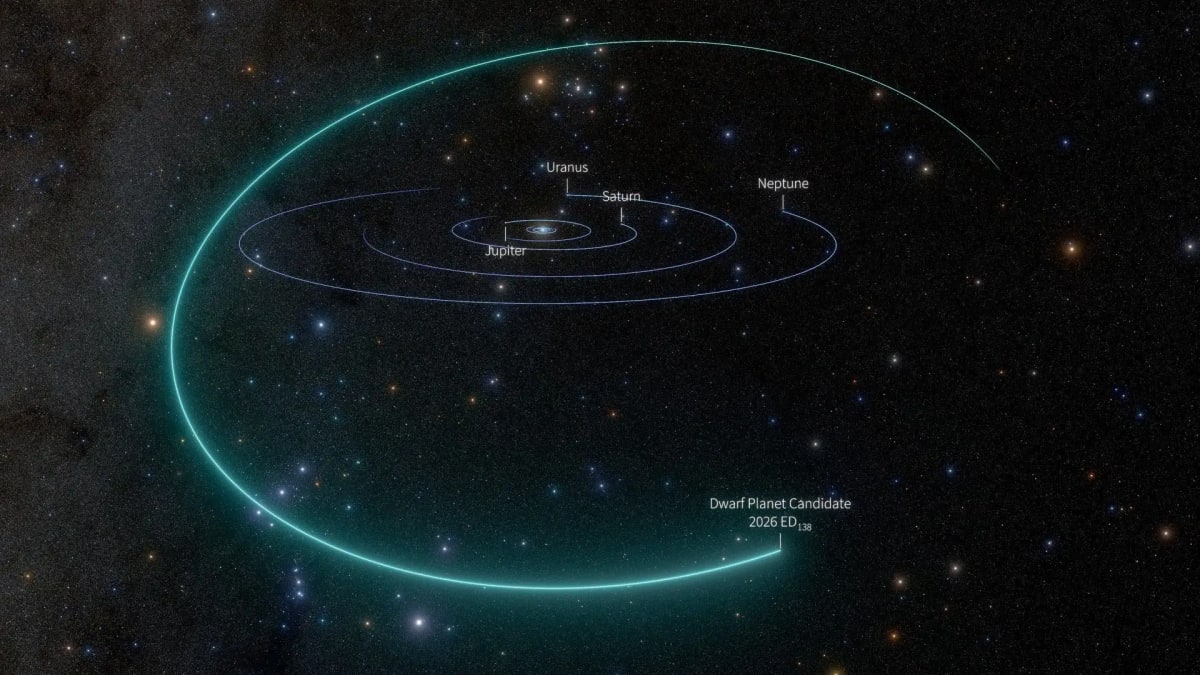
Astronomers analyzing data from a powerful observatory in Chile have identified a mysterious icy body moving among planets beyond neptune. This newly spotted candidate, designated as 2026 ED138, measures roughly 600 to 1,500 kilometers wide and could potentially join the exclusive group of recognized dwarf planets in our cosmic neighborhood.
Detection by the Vera Rubin Observatory
The discovery came to light when Matthew Holman, a researcher at the Center for Astrophysics | Harvard & Smithsonian, ran recent observatory data through a customized search code developed alongside colleague Kevin Napier. The search isolated a surprisingly bright object far past Neptune's orbit. Further checks revealed that the Vera Rubin Observatory captured the body across multiple sessions between March 4 and July 11, while archival data showed earlier sightings by the Dark Energy Camera starting back in 2016.
Characteristics and Orbit
Positioned approximately 46 astronomical units away from the sun, 2026 ED138 sits well beyond Pluto's average distance of 40 astronomical units. Scientists note that its orbit is tilted by about 25 degrees relative to the plane of the solar system, suggesting it experienced a past gravitational encounter with Neptune that knocked it off kilter. Because of its massive scale, researchers believe its own gravity is strong enough to shape it into a sphere—a defining trait separating dwarf planets from typical space rocks.
Next Steps for Confirmation
While the object's existence is verified, confirming its exact classification as a dwarf planet requires more precise measurements of its size. Researchers indicate that future observations using infrared light wavelengths will be essential to settle its status definitively.
Frequently asked questions
What object was discovered beyond Neptune?
Who discovered the dwarf planet candidate?
How far is the object from the sun?
What telescope found the object?
Related stories

Central Board of Secondary Education Prepares for Upcoming 2027 Exams
Students await the official Central Board of Secondary Education schedule for the 2027 examinations, following the closure of candidate list submissions.

Local Holiday Declared for Thiruvalla Taluk Due to Parumala Perunal
A local holiday has been officially declared for all government offices and educational institutions within the Thiruvalla region on Monday.

Royal Enfield Himalayan 750 Teased Ahead of Expected EICMA Reveal
Royal Enfield has shared a video teaser for the upcoming royal enfield himalayan 750, pointing toward a debut at the EICMA exhibition.

Calicut FC Secures Dominant Win in Latest Super League Kerala Match
Calicut FC triumphed over Malappuram FC with a 6-2 scoreline in a recent Super League Kerala encounter, claiming the top spot in the standings.