Insights From Simulating Colliding Wormholes Gravitational Waves
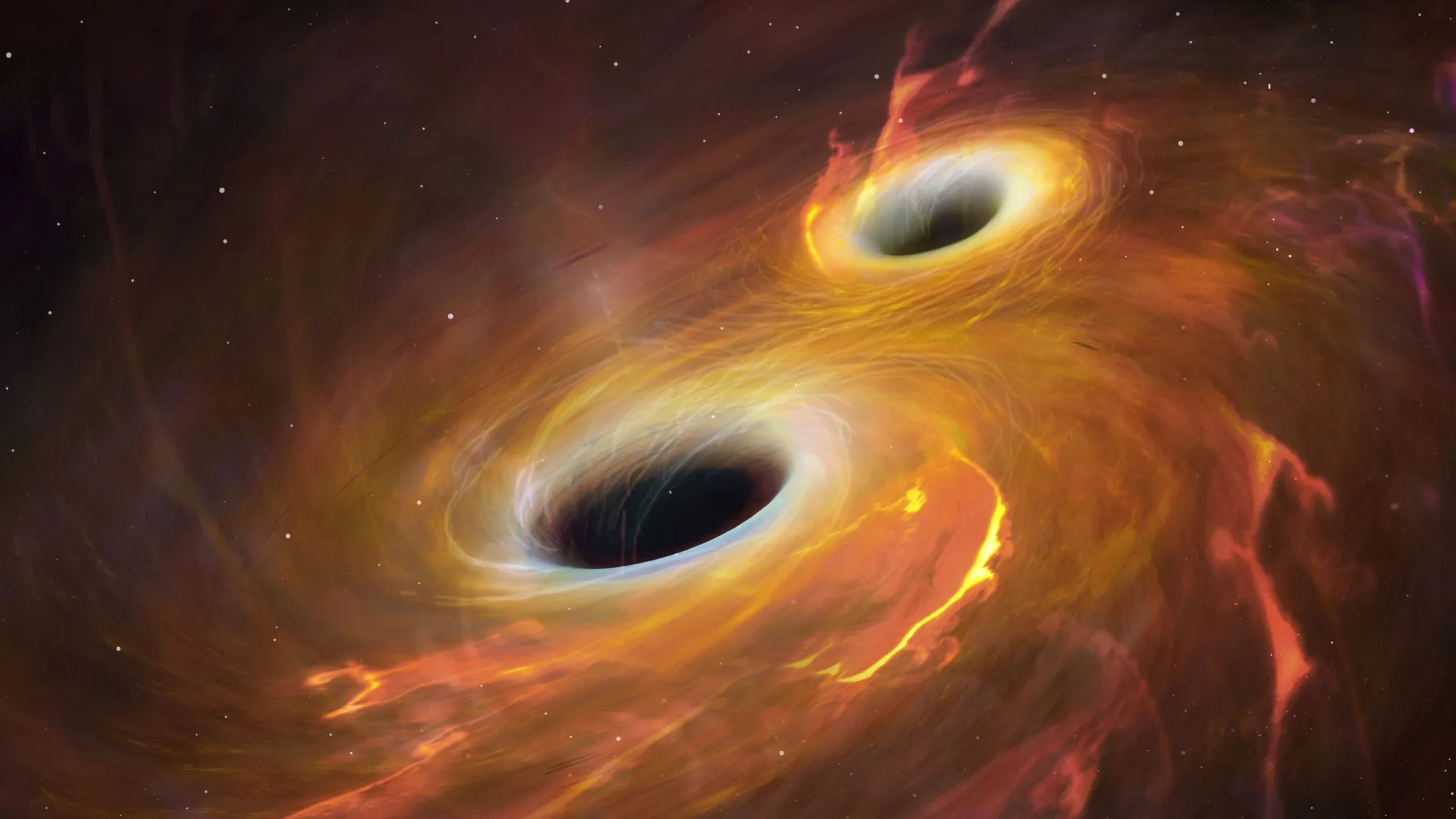
Physicists have run new three-dimensional computer models examining how binary wormholes interact when they cross paths. The research demonstrates that these hypothetical passages could generate distinct signals in spacetime that differ from standard black hole mergers.
While gravitational wave detectors have logged numerous ripples primarily tied to dense black hole collisions, researchers continue to investigate alternative cosmic sources. This recent work explores whether interacting cosmic tunnels might leave unique footprints in the cosmos.
Understanding Ellis-Bronnikov Wormholes
Wormholes are rooted in mathematical possibilities emerging from Albert Einstein's theory of general relativity. While Einstein-Rosen bridges are non-traversable, the Ellis-Bronnikov model represents a traversable passage kept open by a hypothetical phantom scalar field.
This exotic field possesses negative-energy properties that prevent the throat from pinching shut. However, the structure remains volatile, meaning even minor disturbances can cause the throat to collapse into a black hole or undergo runaway expansion.
Bizarre Results and Horizon Shrinking
To examine what occurs when two volatile structures interact, researchers Nikita M. Shirokov and Ilya Nachevsky simulated pairs of Ellis-Bronnikov wormholes with varying initial separations and field properties.
Depending on the configuration, some wormholes attracted or repelled each other while their throats expanded. In other scenarios, a common apparent horizon formed around both throats. Uniquely, that horizon shrank by approximately 28 percent as the phantom scalar field fell into the collapsing region.
Under ordinary circumstances, Stephen Hawking's 1971 area theorem dictates that black hole event horizons can only expand or remain stable. Because this simulation featured an apparent horizon and a field violating standard energy assumptions, the shrinking behavior occurred without contradicting established rules.
Gravitational Wave Signatures
As massive objects move and spiral inward, they shift spacetime and emit ripples known as gravitational waves. The study indicates that massive Ellis-Bronnikov wormholes would also generate these signals during interactions, though their patterns would differ from the characteristic chirp produced by spiraling black holes.
Sources: ScienceAlert, شبكة تواصل الإخبارية, vijesti.me.